

































MAGIC QUADRANT™ / IDP
Infrrd Named a Leader in the 2026 Gartner® Magic Quadrant™ for Intelligent Document Processing, for the Second Year Running
Download the full report to see why and compare leading IDP vendors.
Download reportA self-serve API for developers to parse, extract, evaluate, correct, and deploy document AI applications.
Enterprise-grade output backed by Infrrd's platform intelligence, trained on 10M+ documents. Parse, classify, extract, and review in steps or all at once.


Get full control over the models, workflows, data agreements, and costs behind every extraction pipeline, all on a custom, enterprise-grade IDP platform.
With IDP Forge, you can:
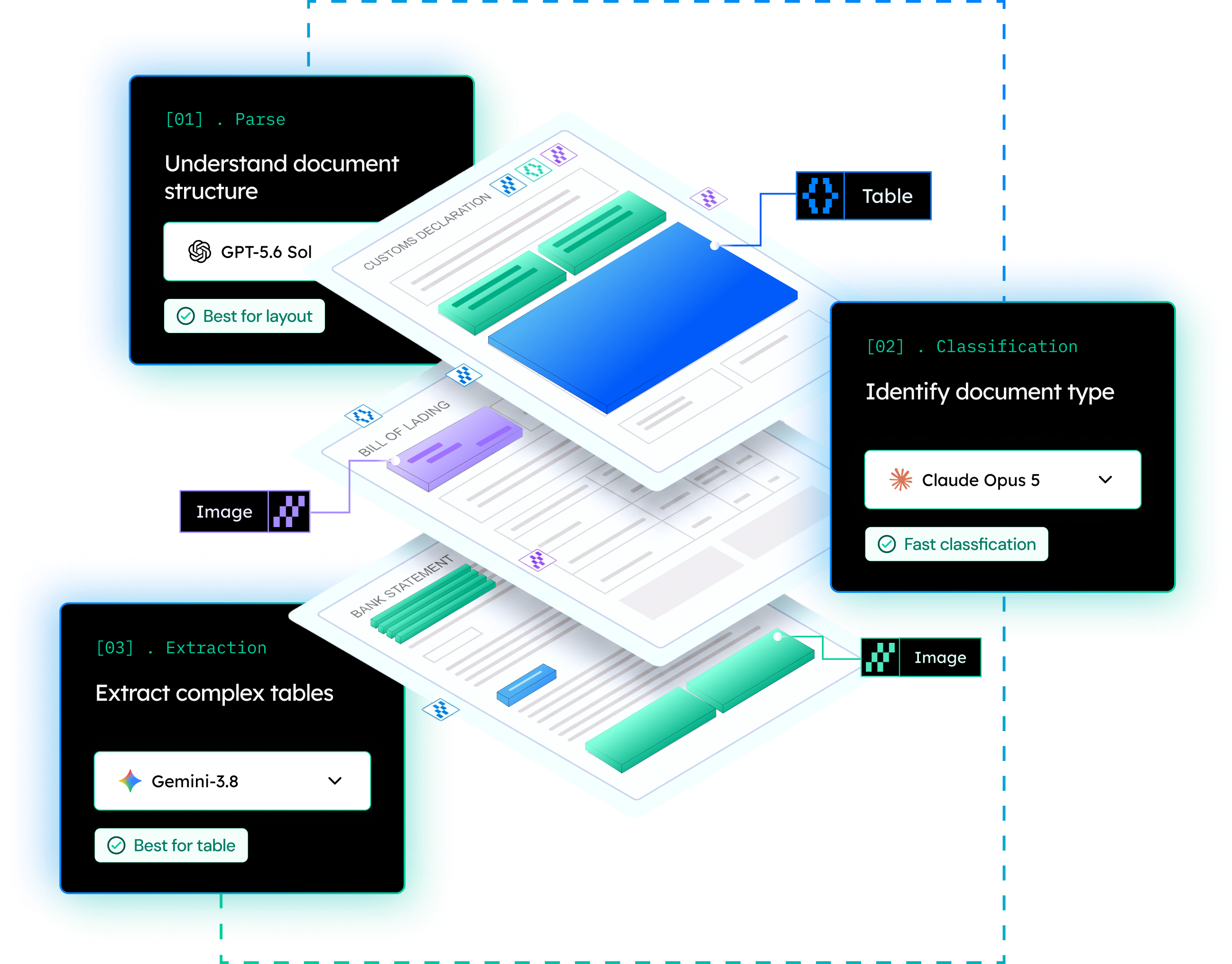
Not one model for everything! Choose from GPT-4o for layout understanding, Claude for complex tables, Gemini for classification, or any combination you want to achieve the best balance of accuracy and cost across your extraction pipeline.


Automatically route documents with errors or low-confidence fields to a dedicated review interface, where you or assigned team members can verify the source, correct the data, and approve the final output.
View cost estimates before processing begins, compare Economy, Standard, and Premium tiers, set budget alerts, and automatically switch models when spending thresholds are reached.


Not one model for everything! Choose from GPT-4o for layout understanding, Claude for complex tables, Gemini for classification, or any combination you want to achieve the best balance of accuracy and cost across your extraction pipeline.
Build confidently with Infrrd's patented, analyst-recognized Intelligent Document Processing platform.
Trusted by industry leaders. 12+ patents, analyst recognition, and strong G2/Capterra reviews.
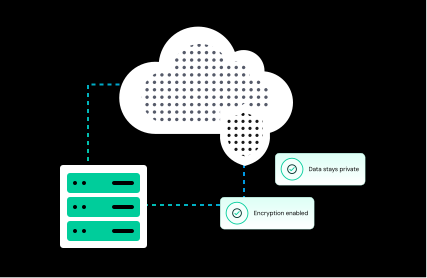
Built for regulated industries. SOC 2 and GDPR-ready security for enterprise-grade compliance.
Choose flexible deployment across cloud, on-premises infrastructure, or a secure virtual private environment.
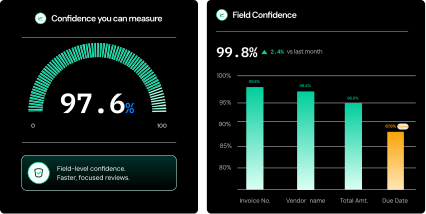
Confidence you can measure. Field-level confidence scores show exactly how reliable each extraction is.
10,000,000,000
pages processed through Infrrd’s core IDP platform
Create a custom extraction model, define the fields you need, configure your preferred LLMs, and start processing documents without waiting through a traditional IDP implementation.
01
Start and choose the right model for each stage
02
Process the document
[Parse, Split, Extract]
03
Route uncertain fields to human review
04
Capture corrections and improve future accuracy
05
Evaluate the new model against the golden data
06
Deploy only when performance improves
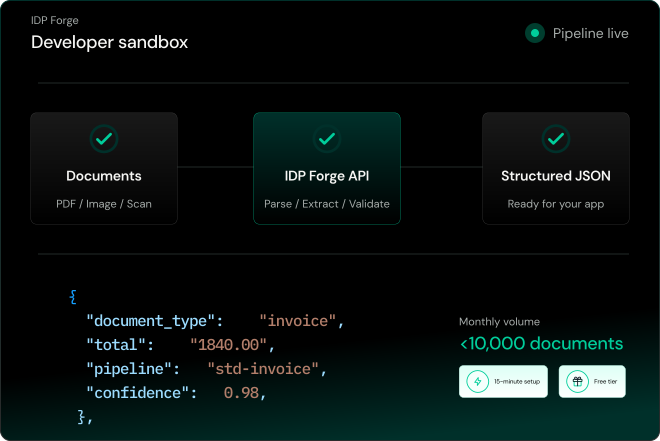
10,000 documents?Build your first pipeline in IDP Forge, make your first API call in under 15 minutes, and start on the free tier.
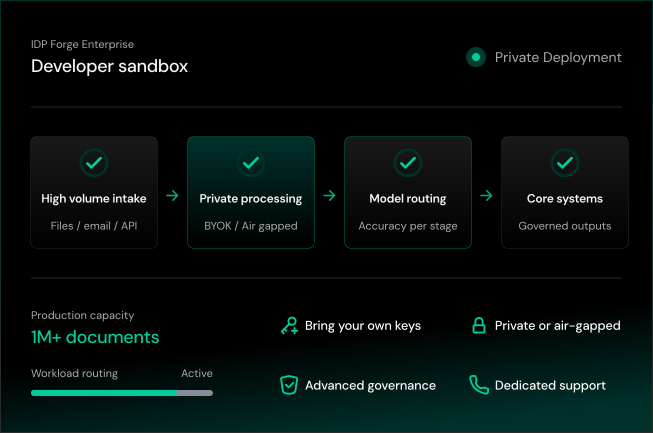
1M documents?Get BYOK, private or air-gapped deployment, dedicated support, advanced governance, and volume pricing for production workloads.
Evaluation Mode lets you run ground-truth tests against your own labeled data and get back an F1 report, so you can validate accuracy on your actual document types before deploying a pipeline to production — rather than relying only on general benchmark numbers.
Primarily developer teams building document pipelines, RAG systems, or AI agents that need reliable structured output from documents — rather than back-office teams looking for a no-code review-and-approval workstation.
IDP Forge is a document AI platform built for developers who need to turn unstructured documents — PDFs, scans, forms, contracts — into structured, machine-usable data. It's built around a Parse API (document → structured JSON/markdown) and an Extract API (schema-based field extraction), with additional Split and Classify capabilities for routing mixed document batches.
Traditional IDP platforms are built around human review queues, validation workflows, and case management. IDP Forge is API-first: it's designed to be embedded directly into software and AI pipelines, with a developer-facing evaluation and confidence-scoring layer instead of manual review stations.
IDP Forge returns a confidence score for each extracted field, not just an overall document-level score. This lets you build auto-approval workflows where high-confidence fields pass through automatically and low-confidence fields get flagged for review.